
Why Am I Always Broke? The Money Story Holding You Back
Quick answer: Most people stay broke not because they earn too little, but because subconscious money beliefs — what I call a money story — silently shape every financial decision they make.
Here’s how to identify yours and change it
If someone handed you an extra $1,000 right now, what would happen to it in 90 days?
If your honest answer is:
“It’d probably be gone.”
You’re not alone. Over 26% of U.S households live paycheck to paycheck.
And yet the most common advice out there —
- budget better
- spend less
- earn more
—isn’t solving the real problem.
Because the real problem often isn’t your income.
It isn’t your discipline either.
It’s something most personal finance advice never addresses:
Your money story.
Until you understand yours, no budget template, savings app, or finance video is going to create lasting change.
Here’s why—and what to do about it.
What Is a Money Story (and Why Does It Control Your Finances)?
Your money story is the set of beliefs, emotions, and patterns around money that were installed in you before you were old enough to question them.
It’s not something you chose. It’s something you absorbed — from the things you heard growing up, the things you witnessed, and the financial experiences that shaped your early life.
Most people treat personal finance like it’s a math problem: earn more, spend less, invest the difference. The math matters — but it’s not the foundation.
If your money story is running in the background, telling you that wealth isn’t for people like you, or that money always disappears, or that wanting more is selfish — the math won’t save you.
That’s why free financial education is everywhere and yet the majority of people are still stuck. Knowing what to do is not the same as being built to do it. Your money story is what determines which one you are.
How Your Money Story Was Formed
Your relationship with money wasn’t random. It was shaped by three specific channels:
What you heard:
“Money doesn’t grow on trees.” “Rich people are greedy.” “We can’t afford that.” These weren’t just phrases — they were beliefs passed down to you. Most of us are still operating on that same programming today, without knowing it.
What you saw.
Did you grow up watching adults argue over money? Did you see it spent immediately when it arrived, or hoarded out of fear? Your brain took notes on all of it. Whatever you witnessed became your working model for how money works.
What you experienced.
Childhood financial instability, a parent losing a job, sudden loss or sudden abundance — these experiences created emotional memories tied to money. And emotional memories drive behaviour at a level that logic alone cannot override.
Here’s what this means practically: you can give two people the same income and the same opportunities, and they’ll get completely different results — because their money stories are different.
This isn’t an excuse. It’s a diagnosis. And once you have a diagnosis, you can build a real plan.
The 5 Broken Money Stories That Keep People Stuck
Most people fall into one — or more — of these five patterns. Read them honestly and see which one resonates.
“Money is scarce and hard to get.”
People running this story work hard but self-sabotage when things start going well. Abundance feels uncomfortable and unfamiliar, so they find ways — consciously or not — to return to struggle. This is one of the most common reasons high earners stay broke.
“Rich people are bad people.”
This story is common in communities where wealth was historically associated with exploitation or corruption. If you subconsciously believe that wealthy people are morally compromised, you will avoid becoming one — even while telling yourself you want financial freedom.
“I’m just not good with money.”
This is an identity story, and identity stories are the hardest to shift because they feel like facts. But you haven’t always been “bad with money.” You’ve been behaving according to a pattern you inherited. Patterns can be changed. Identity can be rebuilt.
“Money will sort itself out eventually.”
The procrastination story. Usually held by optimistic, avoidant people who believe things will work out without a specific plan. Sometimes they do — just never as well as they would have with real intention behind them.
“I don’t deserve wealth.”
This is the most painful one, and the most common among first-generation wealth builders — people from immigrant backgrounds, people of colour, people who grew up with very little. There’s a quiet belief that wealth is for other people. That having more would somehow be a betrayal of where you came from.
It’s not. Building wealth is the fulfilment of what your parents sacrificed for. You are allowed to win.
Discover Your Own Money Story
Reading about limiting beliefs is one thing. Identifying your own is another.
If this article made you realize that one of these money stories sounds familiar, don’t stop at awareness.
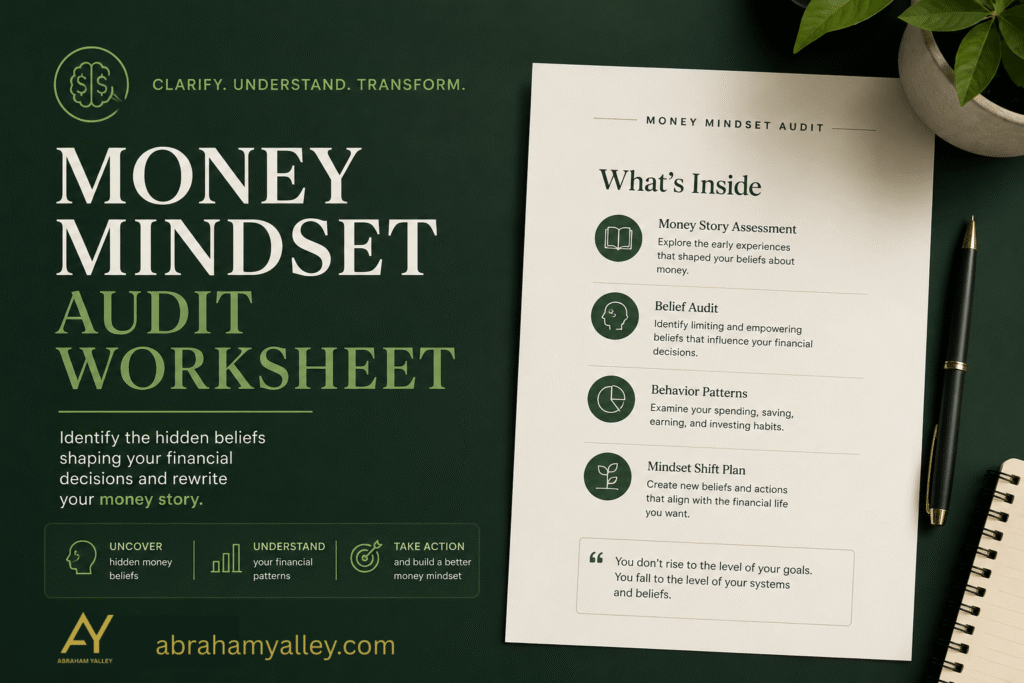
I created the Money Story Audit Worksheet to help you uncover the beliefs shaping your financial decisions, understand where they came from, and begin rewriting them through six guided reflection exercises.
→ Download the Money Story Audit Worksheet
How to Rewrite Your Money Story: A 3-Step Framework
Awareness is the starting point, but it’s not the destination. Here’s the practical framework to actually change your financial behaviour from the inside out.
Step 1: Name your current story
You cannot change what you haven’t identified. A simple exercise: write down the first three words that come to mind when you think about money. Don’t overthink it. Those words will show you exactly what story you’ve been running — and where your real work begins.
Step 2: Challenge the story with evidence
Once you’ve named it, interrogate it. Is it actually true? Where did it come from? Are there people from your same background, your same starting point, who built financial stability? What did they do differently? The answer is almost never luck. It’s almost always a different story.
Step 3: Act your way into a new story
You can’t simply decide to believe something new. You have to build evidence for it through repeated action. Every time you stick to a budget, you prove to yourself that you’re someone who manages money well. Every time you invest — even a small amount — you reinforce that wealth is possible for you. Small, consistent actions rewire the story over time.
Why Mindset Work Comes Before Money Strategy
Before you open a budget spreadsheet, set up an investment account, or start a debt payoff plan — this inner work comes first.
All of those tools are only as effective as the mindset running underneath them. The people who create lasting financial change don’t just change their habits — they change what they believe is possible for them.
This is the foundation that most personal finance content skips, because it’s harder to package than a “5-step savings plan.” But it’s also the reason why people who do this work tend to make real, compounding progress — while everyone else keeps restarting from zero.
Your One Action for Today
Before you do anything else with your finances — before the next article, the next app, the next plan — do this one thing:
Write down the first three words that come to mind when you think about money.
Three words. Honest ones. No editing. Because those words are the doorway into your money story — and understanding your story is where real financial change begins.
Ready to Rewrite Your Money Story?
The Money Story Audit Worksheet is a guided workbook designed to help you uncover your hidden money beliefs, challenge limiting narratives, and build healthier financial habits through practical reflection exercises.
✔ Identify your subconscious money story
✔ Discover the beliefs shaping your financial decisions
✔ Create a practical plan for lasting change
✓ Instant download
✓ Practical reflection exercises
✓ Yours to keep forever
→ Get the Worksheet